Carlos Courtney
Growth Partners
The Ultimate Guide to EBITDA Growth Partnership Strategies

Hey everyone, welcome to our guide on EBITDA growth partnership strategies. You know, sometimes growing a business feels like trying to herd cats, right? Lots of moving parts, and you want to make sure all that effort actually pays off where it counts. That's where looking at EBITDA, and how partnerships can help boost it, really comes into play. We're going to break down some practical ways to make your business more profitable, focusing on strategies that actually work.
Key Takeaways
Focus on revenue growth that doesn't hurt your profit margins. It's not just about selling more, but selling smarter.
Keep an eye on your costs. Cutting unnecessary expenses or renegotiating with suppliers can make a big difference to your bottom line.
Make your operations run smoother. Finding ways to cut out wasted time or effort in your processes helps boost efficiency.
Use data to make better choices. Knowing your numbers helps you figure out what's working and what's not.
Technology and automation aren't just buzzwords; they can seriously cut down on manual work and free up your team for more important tasks.
Introduction

So, you're looking to boost your company's bottom line, specifically that EBITDA number? It's a common goal, especially when you're thinking about selling the business or just want to show solid growth. But how do you actually get there? It's not just about selling more stuff; it's about selling smarter and making sure the money you make sticks around. We're talking about strategic partnerships that directly impact your operating profitability.
Think about it. You've got your core business, and then you've got all these other moving parts – sales, marketing, operations, technology. When these parts aren't working together smoothly, or when you're missing out on opportunities, your EBITDA takes a hit. It's like trying to drive a car with one wheel out of alignment; you're using more fuel and not getting anywhere fast.
This guide is all about figuring out how to make those parts work together, and how to bring in outside help – a growth partner – to make it happen. We'll look at practical ways to improve your business operations and marketing efforts, not just to increase revenue, but to increase profitable revenue. We'll cover how to make your sales process more efficient, how marketing can actually add to your profit margins, and why having good data is non-negotiable. It's about building a business that's not just bigger, but also more valuable and easier to manage. We'll explore how a growth partner can help you define what growth really means for your business, going beyond just the top-line numbers to focus on efficiency and scalability. This structured approach is key to smart, profitable growth and ultimately, increasing your business value. Understanding your numbers is the first step in this journey.
We'll break down specific strategies that have been proven to work, showing you how to implement them in your own company. It's not about magic formulas, but about applying solid business principles with the right kind of support.
We'll also touch on how technology plays a role and look at a real-world example of how a partnership made a big difference. By the end, you should have a clearer picture of how to approach EBITDA growth and why a partnership might be the missing piece of your puzzle. Remember, EBITDA, or Earnings Before Interest, Taxes, Depreciation, and Amortisation, is a key indicator of your company's operational performance.
What is a Growth Partnership and Why Does it Matter for EBITDA?
So, what exactly is a growth partnership, and why should you care about it when we're talking about EBITDA? Think of it as a collaboration, usually between a company and an external expert or firm, focused squarely on boosting that company's growth. This isn't just about bringing in someone to do a task; it's about a strategic alliance aimed at improving key business metrics. And when it comes to EBITDA, this kind of partnership can be a real game-changer.
EBITDA, or earnings before interest, taxes, depreciation, and amortization, is a way to look at a company's operating performance. It strips away things like financing costs and accounting choices to show you how well the core business is actually doing. A strong EBITDA is often seen as a sign of a healthy, efficient operation. It's a metric that investors and potential buyers pay close attention to because it gives them a clearer picture of a company's ability to generate cash from its day-to-day activities. This is why focusing on EBITDA is so important for any business looking to grow or prepare for a sale. The right growth partnership model can directly impact this figure.
Here's why these partnerships matter for EBITDA:
Focused Expertise: Growth partners often bring specialized knowledge in areas like sales, marketing, or operations that a company might lack internally. This focused approach can lead to quicker, more effective improvements.
Objective Perspective: An outside partner can offer an unbiased view of your business, identifying inefficiencies or opportunities that might be overlooked by those too close to the daily operations.
Accelerated Implementation: With a clear mandate and dedicated resources, growth partners can often implement strategies faster than an internal team might be able to, leading to quicker EBITDA improvements.
Alignment with Investor Goals: Many private equity firms, for example, use a growth partnership model to actively improve their portfolio companies. They focus on revenue growth and operational efficiency, closely monitoring key performance indicators like EBITDA, before timing a strategic exit to maximize returns [e8f9].
Essentially, a growth partnership is about bringing in a focused, expert ally to help you achieve specific business objectives. When those objectives include boosting operational profitability, the impact on EBITDA can be substantial. It's about working smarter, not just harder, to make your business more valuable. This is where strategies like using marketing as an EBITDA multiplier come into play, turning promotional spend into a direct driver of profitability.
The Playbook: 5 Core EBITDA Growth Strategies
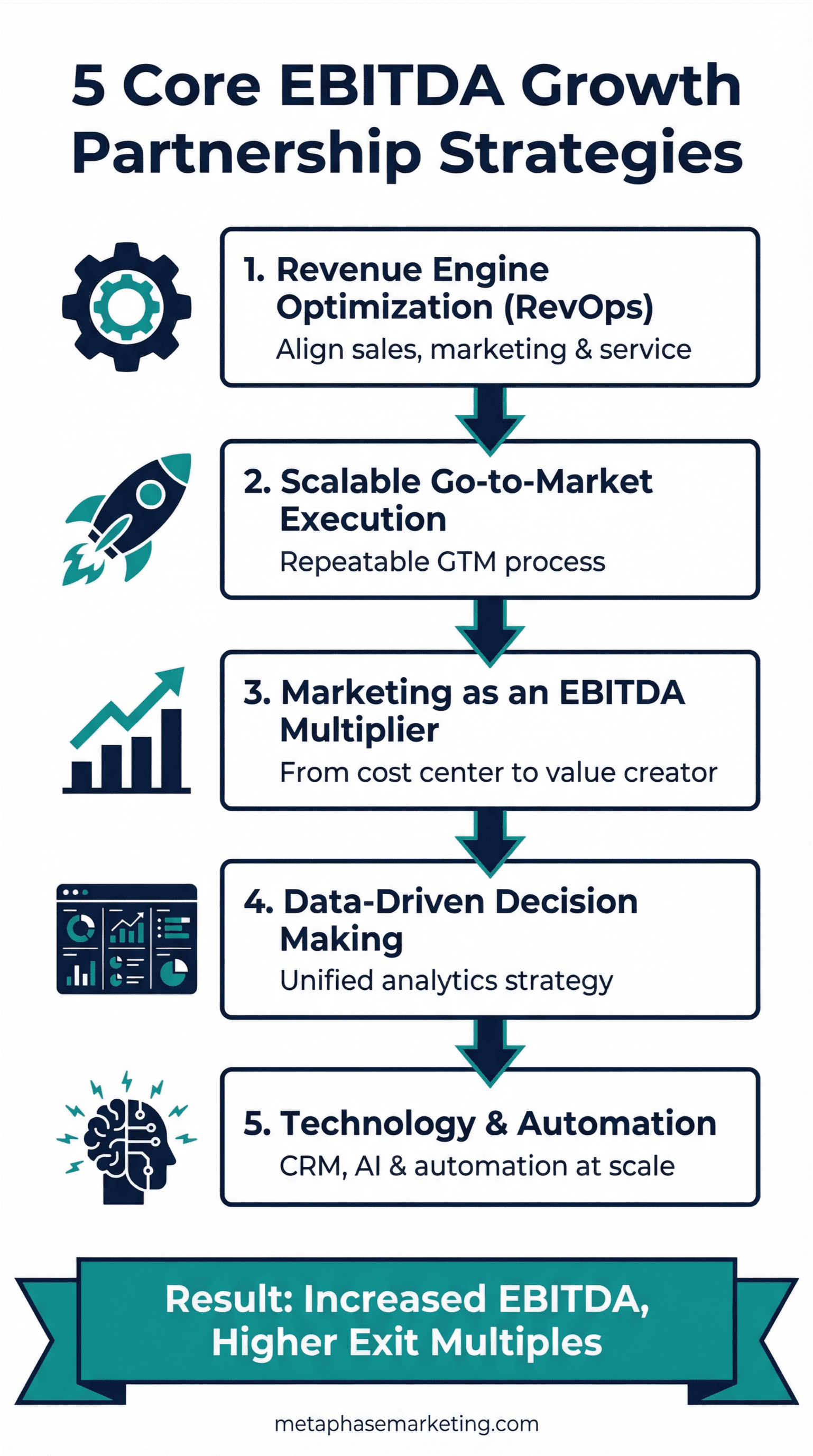
Alright, let's get down to business. We've talked about what a growth partnership is and why it's a big deal for your EBITDA. Now, how do we actually do it? This section is your playbook, laying out five key strategies that private equity firms and smart business leaders use to really move the needle on profitability. It's not about magic; it's about disciplined execution.
Strategy 2: Scalable Go-to-Market (GTM) Execution
Think of your GTM strategy as the engine that drives revenue. For EBITDA growth, this engine needs to be powerful and efficient. It's not just about selling more; it's about selling smarter and making sure each sale contributes positively to the bottom line. This means having a clear plan for how you reach customers, convert them, and keep them coming back, all without costs spiraling out of control. A well-oiled GTM machine is fundamental to increasing EBITDA.
Here’s what that looks like:
Targeted Customer Acquisition: Knowing exactly who your best customers are and focusing your sales and marketing efforts there. No more spraying and praying.
Optimized Sales Processes: Streamlining how your sales team operates, from lead qualification to closing deals. This often involves better tools and training.
Effective Customer Retention: It's way cheaper to keep an existing customer than to find a new one. Focus on delivering great service and building loyalty.
Channel Strategy: Deciding the best ways to sell – direct, through partners, online – and making sure those channels work together efficiently.
When your GTM strategy is scalable, you can handle more business without needing a proportional increase in staff or resources. This directly impacts your operating leverage and boosts EBITDA.
Strategy 3: Marketing as an EBITDA Multiplier
Many see marketing as just a cost center. But when done right, it's a powerful engine for increasing EBITDA. It's about more than just brand awareness; it's about driving qualified leads, supporting sales, and even influencing pricing power. Think of marketing not as an expense, but as an investment that should yield a clear return.
Consider these points:
Performance Marketing: Focusing on campaigns that directly drive measurable results, like leads or sales, and tracking their ROI closely.
Content Strategy: Creating valuable content that attracts your ideal customers and positions you as an authority, reducing reliance on expensive advertising.
Brand Building: A strong brand can command premium pricing and improve customer loyalty, both of which positively impact margins.
Customer Lifetime Value (CLV): Marketing plays a role in nurturing existing customers, increasing their spend over time, and reducing churn.
Strategy 4: Data-Driven Decision Making
Gut feelings have their place, but when you're serious about EBITDA growth and private equity value creation, you need data. Relying on solid numbers helps you make smarter choices about where to invest your time and money. It’s about understanding what’s working, what’s not, and why.
Key areas where data makes a difference:
Customer Analytics: Understanding purchasing patterns, churn rates, and customer profitability.
Sales Performance Metrics: Tracking conversion rates, deal velocity, and sales rep productivity.
Marketing Campaign Performance: Measuring cost per lead, cost per acquisition, and campaign ROI.
Operational KPIs: Monitoring efficiency, production output, and quality control.
This analytical approach helps identify opportunities for cost savings and revenue enhancement that might otherwise be missed. It’s about making informed choices that directly contribute to a healthier EBITDA. For businesses looking to maximize their valuation, understanding these metrics is key to a successful exit strategy.
Strategy 5: Technology & Automation
In today's world, technology isn't a luxury; it's a necessity for efficient operations and growth. Automation can take repetitive, time-consuming tasks off your team's plate, freeing them up for more strategic work. This not only improves efficiency but also reduces errors and can significantly cut labor costs, directly boosting your EBITDA.
Think about:
Automating Workflows: Using software to handle tasks like invoicing, data entry, or customer onboarding.
Implementing CRM Systems: Better managing customer relationships and sales pipelines.
Utilizing ERP Solutions: Integrating various business functions for better oversight and efficiency.
Exploring AI and Machine Learning: For more advanced analytics, predictive modeling, and personalized customer experiences.
By investing in the right technology, you create a more agile and cost-effective business, which is exactly what investors look for when assessing potential for private equity value creation.
Case Study: How an Embedded Growth Partner Accelerated an Exit
Let's look at a real-world example of how bringing in an embedded growth partner can really speed things up, especially when a company is looking to sell. Think about 'Innovate Solutions,' a mid-sized software company. They had a solid product, a decent customer base, but their EBITDA wasn't quite hitting the numbers the investors wanted for a quick, profitable exit. The problem wasn't a lack of effort; it was more about having the right focus and the right people driving specific growth initiatives.
Innovate Solutions decided to bring in an embedded growth partner, 'Growth Accelerators Inc.', for a six-month engagement. Their goal was clear: boost EBITDA by 15% to make the company more attractive to potential buyers. Growth Accelerators didn't just come in with a generic plan; they embedded a small team directly into Innovate Solutions' operations. This meant they were working side-by-side with the sales, marketing, and product teams every single day.
Here's what they focused on:
Optimizing the Sales Funnel: They analyzed every stage of the sales process, identifying bottlenecks. This involved implementing better lead scoring, refining sales scripts, and improving follow-up cadences. They found that a significant number of leads were falling through the cracks simply due to inconsistent follow-up.
Targeted Marketing Campaigns: Instead of broad marketing efforts, they shifted to highly targeted campaigns based on customer data. This meant focusing on segments with the highest potential for upsell and cross-sell, leading to a higher return on marketing spend.
Streamlining Operations: They looked for inefficiencies in customer support and onboarding. By automating certain repetitive tasks and improving internal communication flows, they reduced operational costs without impacting customer satisfaction.
Pricing Strategy Review: A deep dive into their pricing model revealed opportunities to adjust tiers and add-on services that better reflected the value delivered to different customer segments.
The results were pretty impressive. Within five months, Innovate Solutions saw a 17% increase in EBITDA. This wasn't just about cutting costs; it was about smarter revenue generation and more efficient operations. The clear, data-backed improvements made the company a much more compelling acquisition target. When they went to market, they received multiple offers, ultimately leading to an exit that exceeded the initial investor expectations, all thanks to the focused, embedded approach.
Bringing in an external team that lives and breathes your business challenges can often provide the fresh perspective and dedicated execution needed to move the needle on key financial metrics. It's about focused action, not just advice.
Conclusion
Wrapping things up, it's clear that EBITDA growth partnerships aren't about quick wins—they call for hands-on commitment, steady process changes, and real teamwork between internal and external partners. The companies that see the biggest improvements in EBITDA take small, repeatable actions every month, not just massive leaps now and then. They standardize their reporting, weed out manual tasks, and push for clear roles across departments. These practical steps often go a lot farther than any buzzword-filled initiative.
Let's revisit the main lessons from this guide:
Focus on scalable, efficient processes by blending technology and integrated teams.
Use ongoing data—don't just look at spreadsheets once a quarter. Build habits around real-time insights.
Set up accountability, so it's obvious who's responsible for what, not only in the org chart but in day-to-day work.
EBITDA growth is about progress, not perfection. Most companies won't fix everything overnight, but steady moves in the right direction really compound as time goes on.
If you're getting ready for an exit, trying to impress investors, or just want to run a leaner operation, a few adjustments around process discipline and people management can make all the difference. There's no silver bullet here—just honest tracking, team clarity, and a little bit of patience with the process. Stick with it and EBITDA growth doesn't need to be out of reach.
In conclusion, we've covered a lot of ground. We hope this information has been helpful. Ready to take the next step? Visit our website today to learn more and book your consultation!
Wrapping It Up
So, we've walked through a bunch of ways to get your company's EBITDA looking better. It's not just about cutting costs, though that's part of it. It's really about being smart with your money, making your operations run smoother, and keeping a close eye on what actually makes you money. Whether you're looking to sell the business down the road or just want it to be healthier right now, focusing on these strategies can make a big difference. It takes work, sure, but getting your EBITDA in good shape means your business is in good shape. Keep these ideas in mind, and you'll be well on your way.
Frequently Asked Questions
What exactly is EBITDA and why do businesses care about it?
EBITDA is like a company's score for how well it's doing with its main business, before counting things like loan payments, taxes, and the wear and tear on equipment. Businesses love it because it shows how much money they're making from just doing their job, which helps investors and buyers figure out how valuable the company is.
How can partnering with someone help a business grow its EBITDA?
A growth partner can bring in new ideas and skills to help a business sell more, spend less, or work smarter. Think of them as a coach who helps the team play better. They might help with marketing, making processes smoother, or using new technology to get more done with less effort, all of which boosts EBITDA.
What's a 'Growth Partnership' in simple terms?
A growth partnership is when two companies team up to help one of them get bigger and make more money. It's like a collaboration where one company has expertise or resources that the other needs to improve its performance, especially its earnings.
Can you give an example of a strategy that boosts EBITDA?
Sure! One strategy is to make your sales efforts work better. This means finding more customers who are likely to buy and making sure your sales team is really good at closing deals. When you sell more without spending a ton more money, your EBITDA goes up.
Why is using technology important for EBITDA growth?
Technology can make a huge difference! It can automate tasks that people used to do by hand, which saves time and money. It can also help businesses understand their customers better or manage their operations more efficiently. When things run smoother and cost less, EBITDA gets a boost.
What does 'data-driven decision making' mean for EBITDA?
It means using information and facts, not just guesses, to make choices. By looking at data about sales, costs, and customer behavior, businesses can figure out the best ways to improve their operations and marketing. This smart approach helps them make more money and grow their EBITDA.