
Carlos Courtney
Political Ads
The Real Cost-Per-Vote Breakdown: Digital vs TV vs Door Knocking (Fresh 2025–2026 Numbers)
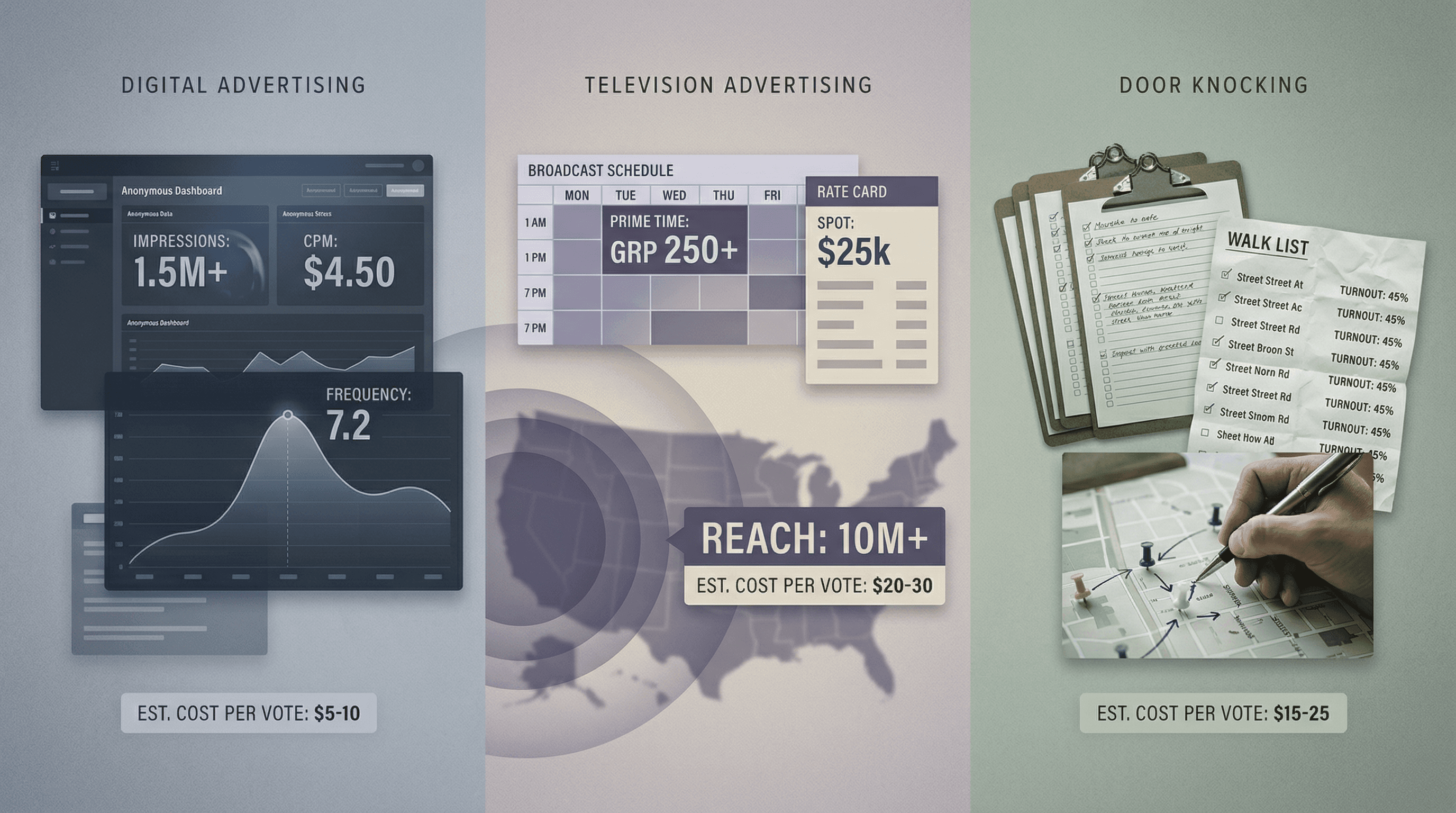
So, you're trying to figure out where to put your campaign money in 2025 and 2026? It's a big question, and honestly, things have changed a lot. Gone are the days when just running TV ads or knocking on doors was enough. Now, it's all about mixing things up, especially with digital tools. We're going to break down what you can expect to pay to reach voters through different methods, focusing on the real cost per vote digital vs TV and how it all stacks up. It’s not just about spending money; it’s about spending it smart to actually get people to vote for you.
Key Takeaways
Digital ad spending is breaking records, and campaigns are shifting more resources online because that's where voters are spending their time.
While TV still has reach, Connected TV (CTV) and streaming ads are becoming more important, offering better targeting than traditional broadcast.
Door-knocking remains a solid tactic for direct voter contact, but it's expensive per voter reached compared to digital methods.
Understanding your cost per vote digital vs TV is key; digital often offers more precise targeting and potentially lower costs for reaching specific voter groups.
Emerging trends like AI for voter segmentation and multicultural outreach are shaping how campaigns spend their money to connect with diverse audiences efficiently.
The Shifting Landscape Of Political Campaign Spending
Digital Ad Spending Shatters Records
It feels like just yesterday we were talking about how much money campaigns were pouring into TV ads. Now? It's a whole different ballgame. Digital ad spending has absolutely exploded, breaking records year after year. In 2025, we saw political parties and candidates spending over a million dollars every single week just on Meta platforms alone. That's a staggering amount of money, and it shows just how much campaigns are betting on reaching voters online. The Ontario provincial election in 2025 was a prime example, with over $50 million shelled out for digital outreach. It's clear that if you're not online, you're pretty much invisible.
Traditional Outreach Versus Digital Dominance
So, what does this mean for the old ways of campaigning? Door-knocking, phone banks, even those flyers you used to get in the mail – they're still around, but they're not the main event anymore. Campaigns are still doing them, sure, but the bulk of the budget and the strategic focus has shifted. Think about it: over 90% of Canadians are online, and millions are active on social media every day. Campaigns have to meet voters where they are, and that's increasingly on their phones and computers. It's not about abandoning traditional methods entirely, but about integrating them with a strong digital-first approach. The goal is to make sure every dollar spent is actually reaching people.
The Growing Influence Of Political Advertising Agencies
Because the digital space is so complex and changes so fast, political advertising agencies have become super important. These aren't just general marketing firms; they're specialists who know the ins and outs of political campaigns. They understand the rules, the platforms, and how to use data to target voters precisely. They're the ones crafting the digital strategies, creating the ads, and figuring out how to get the message out effectively. With shorter campaign timelines and voters' attention spans shrinking, having an agency that can adapt quickly and use tools like AI for targeting is pretty much a necessity for any campaign looking to win.
Digital Strategies For Maximum Voter Reach

Reaching voters in today's world means going where they are, and increasingly, that's online. It's not just about having a website anymore; it's about actively engaging people on the platforms they use every single day. The key is to be smart and targeted, not just loud.
Leveraging Meta Platforms For Broad Engagement
Facebook and Instagram, under the Meta umbrella, are still powerhouses for political campaigns. Think about it: millions of people scroll through their feeds multiple times a day. It's where you can find your voters, whether they're checking in on friends or following local news. The real magic here is the targeting. You can get super specific, showing your message to people based on their age, interests, location, and even behaviors. This means your campaign ads aren't just blasted out randomly; they're shown to folks who are more likely to care about what you're saying. It’s way better than just hoping someone sees a generic ad. We're talking about reaching people who are actually in your USA voter database and might actually vote for you.
TikTok's Rise In Youth Mobilization
Don't sleep on TikTok, especially if you're trying to connect with younger voters. This platform is all about short, authentic videos. Campaigns can use it to show personality, highlight key issues in a quick, digestible way, and even jump on trending sounds (professionally, of course). It feels more real, and that's what younger demographics often look for. It’s a different vibe than traditional ads, and it’s proving effective for getting younger people involved and informed.
YouTube And Google Ads For Targeted Impact
YouTube is huge, and running ads before videos (pre-roll) is a solid way to get your message in front of people. Plus, Google Search ads are gold. When someone is actively searching for information about candidates, voting procedures, or specific issues, you want your campaign to pop up. It captures voters when they're already looking for answers, making it a really direct way to connect. It’s about being there at the exact moment someone is seeking information related to your campaign.
The digital space offers incredible opportunities to connect with voters on a personal level. It's about crafting messages that fit the platform and the audience, rather than just repeating the same thing everywhere. Authenticity and relevance are king.
Here’s a quick look at how different platforms can serve your campaign:
Meta (Facebook/Instagram): Broad reach, detailed targeting, community building.
TikTok: Engaging younger voters, authentic short-form video, trend participation.
YouTube/Google Search: Capturing active searchers, pre-roll ads for broad visibility.
X (formerly Twitter): Real-time updates, engaging with media and influencers, policy announcements.
Understanding Cost Per Vote In Digital Campaigns

So, you're running a campaign and wondering how much you're actually paying to get one person to vote for you, especially when you're looking at digital ads. It's not as simple as just looking at your total ad spend. We need to break it down.
Measuring Return On Investment For Digital Ads
When we talk about ROI for digital ads, we're really asking: did the money we spent bring in enough support to justify the cost? It’s about seeing if your ad spend translates into actual votes or, at the very least, strong voter engagement that could lead to votes. The goal is to spend money efficiently, not just spend a lot of money.
Here’s a simplified way to think about it:
Total Ad Spend: This is everything you put into your digital ads – the money paid to platforms like Meta, Google, or YouTube, plus any costs for creating the ads themselves (graphics, videos, copywriting).
Voter Contact Points: This could be clicks, messages received, or even just impressions (how many times your ad was seen). It’s hard to directly link these to a vote, but they’re steps in the right direction.
Cost Per Vote (CPV): This is the magic number. You figure it out by taking your Total Ad Spend and dividing it by the number of votes you can reasonably attribute to your digital efforts. This is the tricky part – how do you know an ad caused a vote?
It's a bit like trying to figure out which ingredient made a cake taste good. Was it the flour, the sugar, or the secret family recipe? With digital ads, we use analytics to try and connect the dots. Platforms give us data on who saw the ads, who clicked, and sometimes, who took further action. We can look at trends and compare areas where we spent more on digital ads versus areas where we didn't, to see if there was a difference in turnout or support.
The Cost-Effectiveness Of Micro-Targeting
This is where digital really shines. Instead of shouting your message to everyone on TV, you can get super specific. Micro-targeting means you're showing ads only to people who are most likely to be interested or who are undecided and persuadable. Think about it: why pay to show an ad about local park improvements to someone who lives in a different town? It’s a waste of money.
With digital tools, you can target based on:
Location: Down to specific neighborhoods or even zip codes.
Demographics: Age, gender, income level, education.
Interests: Hobbies, online behaviors, pages they like.
Past Voting Behavior: Identifying likely voters or those who have voted in specific party primaries.
This precision means your ad budget goes further. You're not just broadcasting; you're having a more direct conversation with smaller, relevant groups. This can significantly lower your cost per vote because you're reaching people who are more likely to respond positively.
Optimizing Budgets For Specific Demographics
Once you know who you're trying to reach, you can adjust your spending. Some groups might be more expensive to reach online than others. For example, older voters might be more prevalent on Facebook, while younger voters might be more active on TikTok or Instagram. Each platform has its own costs and its own audience.
Here’s a general idea of how costs can vary:
Demographic Group | Typical Platform Focus | Estimated Cost Per Impression (CPM) | Notes |
|---|---|---|---|
Young Adults (18-25) | TikTok, Instagram, YouTube | $5 - $15 | High engagement, but can be fleeting |
Middle-Aged Adults (30-55) | Facebook, YouTube, Google Search | $8 - $20 | Broad reach, good for detailed messages |
Older Adults (55+) | Facebook, Email, some YouTube | $10 - $25 | Loyal users, respond well to direct appeals |
Note: CPM (Cost Per Mille/Thousand Impressions) is a common metric. Actual Cost Per Vote will depend on conversion rates.
So, if you're trying to reach younger voters, you might allocate more budget to platforms where they spend their time, even if the CPM seems a bit higher, because you might get more action from those impressions. Conversely, if you're targeting older voters, you might focus on platforms where they are highly engaged and where your message is more likely to stick. It’s all about smart allocation based on who you need to convince and where they are online. This constant adjustment and testing is key to making sure your campaign dollars are working as hard as possible to get those votes.
Figuring out the true cost per vote in digital campaigns isn't just about dividing ad spend by votes. It involves understanding how different platforms and targeting methods affect reach and engagement. The real win comes from smart budgeting, precise targeting, and continuous analysis to make every dollar count towards persuading voters.
The Evolving Role Of Television Advertising
CTV and Streaming Platform Advertising
Remember when TV ads were just about broad strokes, hoping to catch as many eyeballs as possible? Well, that's changing, fast. While traditional broadcast TV still has its place, the real action is moving to Connected TV (CTV) and various streaming platforms. Think about it: people aren't just watching the same few channels anymore. They're hopping between Netflix, Hulu, Peacock, and a whole bunch of other services. This shift means campaigns can now target ads on these platforms with a level of precision that used to be exclusive to digital. We're talking about reaching voters based on their viewing habits, their location down to the postal code, and even their expressed interests. It's like digital targeting, but on your big screen.
Comparing Digital Versus Broadcast Reach
So, how does this new TV landscape stack up against good old digital ads? It's not really an either/or situation anymore. Digital, especially social media and search, is fantastic for micro-targeting specific groups and having direct conversations. You can test messages quickly and see what sticks. Broadcast TV, on the other hand, still offers that massive, undeniable reach. It's great for building general awareness and making a big splash. But CTV is starting to bridge that gap. It offers a way to get that big-screen feel and broad exposure, but with the data-driven targeting capabilities we've come to expect from digital. Campaigns are increasingly looking at how to blend these approaches, using digital for precision and broadcast/CTV for scale.
The Declining Dominance Of Traditional TV Spots
Let's be real, the days of campaigns pouring almost all their money into 30-second spots on major networks during primetime are fading. Younger voters, in particular, are less likely to be glued to traditional cable. They're cutting the cord and opting for on-demand content. This doesn't mean TV advertising is dead, not by a long shot. It just means the definition of "TV advertising" has expanded. Campaigns that ignore the rise of streaming and CTV are likely missing out on significant chunks of the electorate. It's about adapting to where people are actually watching content today, not where they used to watch it.
The media consumption habits of voters have fragmented significantly. What worked even five years ago might not be as effective now. Campaigns need to be agile, understanding that reaching voters requires a multi-platform approach, with a growing emphasis on personalized delivery through connected devices.
Assessing The Value Of Door-To-Door Canvassing
The Enduring Importance Of Ground Operations
Even with all the fancy digital tools and TV ads, you can't beat a good old-fashioned chat on someone's doorstep. It's a tried-and-true method for a reason. While it might seem old-school, direct voter contact through canvassing still holds a lot of weight. It's where you can really connect with people, answer their questions face-to-face, and get a feel for what's on their minds. This personal touch is something digital outreach often struggles to replicate.
Comparing Direct Voter Contact Costs
Let's talk numbers. How does knocking on doors stack up against other methods? It's not always the cheapest per contact, especially if you're covering a lot of ground. But the quality of that contact can be much higher. A conversation can change minds or solidify support in a way a fleeting ad might not.
Here's a rough look at what you might expect:
Method | Estimated Cost Per Contact | Notes |
|---|---|---|
Door-to-Door | $5 - $20 | High quality, labor-intensive |
Direct Mail | $1 - $5 | Broad reach, lower engagement |
Digital Ads | $0.50 - $5 | Scalable, targeted, can be less personal |
TV/Radio Ads | Varies Widely | High reach, very expensive, less targeted |
Keep in mind these are just ballpark figures. Actual costs depend on your campaign's size, location, and how efficiently you run things.
Integrating Canvassing With Digital Efforts
So, door-knocking isn't dead, but it works best when it's part of a bigger plan. Think of it as the boots on the ground that complement your online presence. Here's how you can make them work together:
Data Collection: Canvassers can gather real-time feedback and identify undecided voters. This info can then be fed back into your digital targeting.
Follow-Up: If a canvasser has a good conversation with someone, they can note that down. Later, you can send targeted digital ads or emails to those specific individuals.
Reinforcement: Seeing a candidate's face on a flyer and then meeting them at the door (or a trained volunteer) can make a message stickier.
GOTV (Get Out The Vote): Canvassing is incredibly effective in the final days of a campaign to remind people to vote and offer assistance.
The real power comes when your digital ads are telling people about issues, and then your canvassers are on the ground having detailed conversations about those same issues. It creates a consistent and powerful message that voters can't ignore. It's about making sure the right people hear the right message, through the right channels, at the right time.
Ultimately, door-to-door canvassing offers a level of personal connection and persuasion that's hard to match. When used smartly alongside digital strategies, it remains a potent tool in any campaign's arsenal for 2025–2026.
Key Trends Shaping 2025–2026 Election Campaigns
Alright, so what's new and noteworthy for the upcoming election cycle? Things are moving fast, and campaigns that don't keep up are going to get left behind. It feels like every election, there's some new tech or approach that shakes things up, and 2025–2026 looks to be no different. We're seeing a real push towards making outreach super personal and efficient.
AI-Powered Voter Segmentation
This is a big one. Artificial intelligence is no longer just a buzzword; it's becoming a standard tool for campaigns. Think about it: instead of broad strokes, AI can help sort through massive amounts of data to figure out exactly who is likely to vote, what issues they care about, and how best to reach them. This allows for incredibly precise messaging, making sure your campaign's resources are spent talking to the people who actually matter. It’s about moving beyond general demographics to understand individual voter behavior and preferences. This kind of hyper-targeting means fewer wasted ad dollars and more impactful communication.
Multicultural and In-Language Outreach
Canada is incredibly diverse, and campaigns are finally catching on that a one-size-fits-all approach just doesn't cut it anymore. Reaching voters in their native languages and understanding cultural nuances is becoming a game-changer. This isn't just about translation; it's about crafting messages that genuinely connect with different communities. Expect to see more campaigns investing in outreach that speaks directly to specific ethnic and cultural groups, using tailored content and platforms.
Data-Driven Get-Out-The-Vote Operations
Getting people to the polls is just as important as convincing them to vote for you. In 2025–2026, this is going to be heavily reliant on data. Campaigns are using sophisticated tools to identify likely supporters and then employing a mix of digital reminders (like texts and emails) and traditional methods to make sure they cast their ballot. It's all about optimizing turnout, especially in close races. This means constantly analyzing data to see what's working and adjusting strategies on the fly.
The focus is shifting from just broadcasting a message to having a genuine conversation with voters. This means understanding their specific concerns and tailoring communication accordingly, using data to inform every step of the process. It’s about being relevant and responsive in a way that builds trust and encourages participation.
Here’s a quick look at how some of these trends might play out:
AI in Action: Identifying swing voters in specific neighborhoods based on past voting patterns and online activity.
Multilingual Content: Developing video ads in Punjabi, Mandarin, and Spanish for key urban ridings.
GOTV Tech: Utilizing SMS campaigns to remind registered voters about polling station locations and early voting opportunities.
Integrated Strategies: Combining targeted digital ads with localized canvassing efforts informed by AI-driven insights.
Campaigns that embrace these trends will likely find themselves better positioned to connect with voters and achieve their electoral goals. It's a complex but exciting time for political strategy, and staying informed is key to making a real impact. You can find more information on revitalizing movements and countries within the next three years here.
So, What's the Bottom Line?
Alright, so we've looked at the numbers, and it's pretty clear that the old ways aren't always the cheapest or most effective anymore. While knocking on doors still has its place, especially for that personal touch, digital campaigns are really stepping up. They let you talk to way more people, super specific people, without breaking the bank like a big TV ad blitz. Think about it – you can hit exactly the voters you need to reach, right on their phones. TV ads? They're still a thing, but man, they cost a fortune and you're kind of just shouting into the void hoping the right ears are listening. For 2025 and 2026, if you're running a campaign and not putting serious thought – and budget – into digital, you're probably leaving votes on the table. It’s not just about being online; it’s about being smart online, reaching the right folks with the right message. That's where the real wins are going to be.
Frequently Asked Questions
Why is digital advertising becoming so important for political campaigns?
Digital ads are key because most people spend a lot of time online. Platforms like Facebook, Instagram, and TikTok let campaigns reach specific groups of voters with messages that really matter to them. It's like talking directly to people where they already are, making it easier to get your ideas out.
How do campaigns figure out the 'cost per vote' for digital ads?
Campaigns track how much money they spend on ads and how many votes they get from those ads. By comparing the spending to the results, they can see how much each vote cost. This helps them decide where to spend their money for the best results.
Is TV advertising still useful for political campaigns?
TV ads used to be the main way to reach voters, but now many people watch shows on streaming services or online. While traditional TV still reaches some people, campaigns are shifting more money to digital ads that can be more precisely targeted and often cost less to reach the same number of people.
Does door-to-door campaigning still work?
Yes, talking to voters face-to-face is still very important. It helps build trust and connect with people on a personal level. Campaigns often use door-knocking along with digital efforts to make sure they're reaching everyone and getting their message out in different ways.
What's new in political campaigns for 2025-2026?
New trends include using smart computer programs (AI) to understand voters better and send them personalized messages. Campaigns are also focusing more on reaching different cultural groups with ads in their own languages and using digital tools to make sure people actually vote.
How does TikTok help political campaigns?
TikTok is great for reaching younger voters. Campaigns use short, fun videos to share their message in a way that feels real and relatable. It's a fast way to get attention and encourage young people to get involved and vote.