Carlos Courtney
Growth Partners
Top 5 Predictive Marketing Platforms for 2026: A Detailed Review

Figuring out what customers will do next is a big deal for marketers. It means you can get them the right message at the right time, and that usually means better results. That's where a good predictive marketing platform comes in. These tools use data to guess what's coming, helping you stay ahead. We looked at a bunch of them to find the top 5 that can really help your marketing efforts in 2026.
Key Takeaways
Salesforce Marketing Cloud Intelligence brings all your marketing data together and uses AI to predict customer actions, helping you personalize messages.
HubSpot Marketing Hub offers a combined CRM and marketing platform, making it easier to manage customer relationships and campaigns.
6sense focuses on account identification and engagement, helping B2B companies find and connect with the right buyers.
Lattice (by Dun & Bradstreet) provides customer data and analytics to help businesses understand their audience better and make smarter marketing choices.
Everstring uses data to help businesses identify and target their ideal customers more effectively, improving marketing outreach.
Introduction
The marketing landscape is always shifting, and staying ahead means using the smartest tools available. For 2026, predictive marketing platforms are no longer a nice-to-have; they're pretty much a necessity if you want to connect with customers effectively. These platforms use data to figure out what your customers might do next, helping you tailor your messages and offers before they even know they need them. It’s about being proactive, not just reactive. We've looked at a bunch of these tools to find the ones that really stand out.
Think about it: instead of guessing what might work, you're using actual data to make educated predictions. This means less wasted effort on campaigns that miss the mark and more focus on what actually drives results. It's a smarter way to spend your marketing budget and time. We've put together a list of the top five platforms that we think will make a big difference for businesses looking to get a competitive edge. These are the tools that can help you understand your audience on a deeper level and act on those insights. Getting this right can really change how you approach your entire marketing strategy, impacting everything from customer acquisition to long-term loyalty. It's all about making your marketing more personal and timely.
Here’s a quick look at what makes these platforms so useful:
Data Analysis: They sift through vast amounts of customer data to find patterns.
Predictive Modeling: They use these patterns to forecast future customer behavior.
Personalization: They help you deliver the right message to the right person at the right time.
Automation: Many can automate actions based on these predictions.
The goal is to move beyond simple segmentation and into true one-to-one marketing, powered by intelligent insights. This shift allows for more meaningful customer interactions and better business outcomes.
We've spent time evaluating how these platforms perform in real-world scenarios, looking at ease of use, the accuracy of their predictions, and how well they integrate with other marketing tools. Our goal was to identify the platforms that offer the most practical benefits for marketers today and in the near future. You can find more details on how we made our choices in the next section, but for now, let's get to the list of the top contenders for 2026. This review aims to help you make an informed decision about which platform might be the best fit for your business needs, especially when considering long-term growth and post-acquisition success.
How We Evaluated the Platforms
So, how did we actually pick these top 5? It wasn't just a gut feeling, believe me. We looked at a bunch of things to make sure these platforms are the real deal for marketers looking to get ahead in 2026.
First off, we checked how well they could pull in data from everywhere. Think your CRM, your ad platforms, your email service – all of it. A platform that can't talk to your other tools is pretty much useless. We also made sure they could handle tons of data without slowing down, because who has time for lag?
Then, we dug into the predictive part. Does it actually help you guess what customers might do next? We looked for features like machine learning and AI that can spot trends and help you figure out who to target. It’s not just about looking back; it’s about seeing what’s coming.
Here’s a quick rundown of what we focused on:
Data Integration: Can it connect to all your existing systems?
Predictive Capabilities: Does it use AI/ML to forecast and identify trends?
Reporting & Dashboards: Are they easy to use and customizable?
ROI Measurement: Can you clearly see what's working and what's not?
Scalability: Will it grow with your business?
We also considered how easy they are to actually use. If it takes a rocket scientist to figure out the dashboard, that’s not going to cut it for most teams. And, of course, we looked at how well they help you understand the whole customer journey, from that first click to the final sale. It’s all about making smarter decisions to drive sustainable business growth [ac24].
Ultimately, we wanted platforms that don't just show you what happened, but help you figure out what's going to happen next and how to make the most of it. That means clear insights, actionable predictions, and a solid understanding of your marketing's impact.
The Top 5 Predictive Marketing Platforms for 2026
Alright, let's get down to the nitty-gritty. Picking the right predictive marketing platform can feel like a puzzle, but it's super important for staying ahead. These tools aren't just about looking at what happened yesterday; they're about figuring out what's likely to happen tomorrow. We've sifted through a bunch of options to bring you the top contenders for 2026. These platforms use smart tech to help you understand your customers better and make your marketing efforts actually work.
Platform 1: Salesforce Marketing Cloud Intelligence (formerly Datorama)
Salesforce Marketing Cloud Intelligence is a big player, and for good reason. It pulls all your marketing data into one spot, which is a lifesaver. Think ads, social media, emails, website traffic – it all gets collected. This means you get a clear picture of how your campaigns are doing. Plus, it uses AI to guess what customers might do next. This lets you tailor messages and experiences, making sure you're talking to the right people at the right time. It's all about making smarter choices and getting better results by really getting to know your audience.
Platform 2: HubSpot Marketing Hub
HubSpot is known for being user-friendly, and its Marketing Hub is no exception. It's great for businesses that want an integrated system. You get your CRM and marketing tools all in one place, which simplifies things a lot. It helps you manage leads, automate campaigns, and analyze performance. While it might not have all the super-advanced predictive features of some other platforms, it does a solid job of providing insights that help you make better marketing decisions. It's a good choice if you're looking for a tool that's easy to use and covers a lot of ground.
Platform 3: 6sense
6sense really focuses on the buyer's journey. It's designed to help you identify and engage with potential customers when they're most likely to buy. This predictive marketing software uses AI to analyze buyer behavior and intent signals. It helps you understand which accounts are in-market and what they're interested in. This means you can focus your sales and marketing efforts on the right targets, making your outreach much more effective. It's a powerful tool for account-based marketing and getting ahead of the competition.
Platform 4: Lattice (by Dun & Bradstreet)
Lattice, from Dun & Bradstreet, brings a data-driven approach to predictive marketing. It's built on a massive amount of data, which helps in making more accurate predictions. This platform is good at identifying growth opportunities and potential risks. It helps you understand your customer base more deeply and predict future trends. For companies looking to make strategic decisions based on solid data, Lattice offers a robust solution. It's particularly useful for understanding market dynamics and customer behavior on a larger scale.
Platform 5: Everstring
Everstring is another strong contender in the predictive marketing space. It focuses on helping businesses find and engage their ideal customers. The platform uses AI to analyze data and identify high-potential leads and accounts. It's designed to improve sales and marketing alignment by providing clear insights into who to target and when. This predictive marketing platform helps cut through the noise and focus on the prospects most likely to convert. It's a great tool for streamlining your outreach and maximizing your return on investment.
Here's a quick look at some key features:
Data Integration: Connects to various data sources.
AI-Powered Insights: Uses machine learning for predictions.
Audience Segmentation: Helps target specific customer groups.
Performance Analytics: Tracks campaign success.
Choosing the right predictive marketing software means looking at how well it fits your specific needs. It's not just about the fancy features, but about whether it can actually help you understand your customers and improve your marketing results.
When you're looking at these tools, think about what you need most. Do you need super detailed customer journey insights, or is a more general overview enough? It's worth checking out reviews and comparing features to find the best fit for your team. You can find more details on how these platforms stack up in marketing analytics platforms for 2026.
These platforms are changing the game for marketers. By using predictive analytics, businesses can move from guessing to knowing, making their marketing spend work harder and smarter. It's an exciting time to be in marketing, with tools like these helping us make better decisions and connect with customers in more meaningful ways. For businesses looking to optimize their operations and drive growth, these tools are becoming increasingly important, much like the focus private equity firms are placing on operational excellence.
Comparison Table
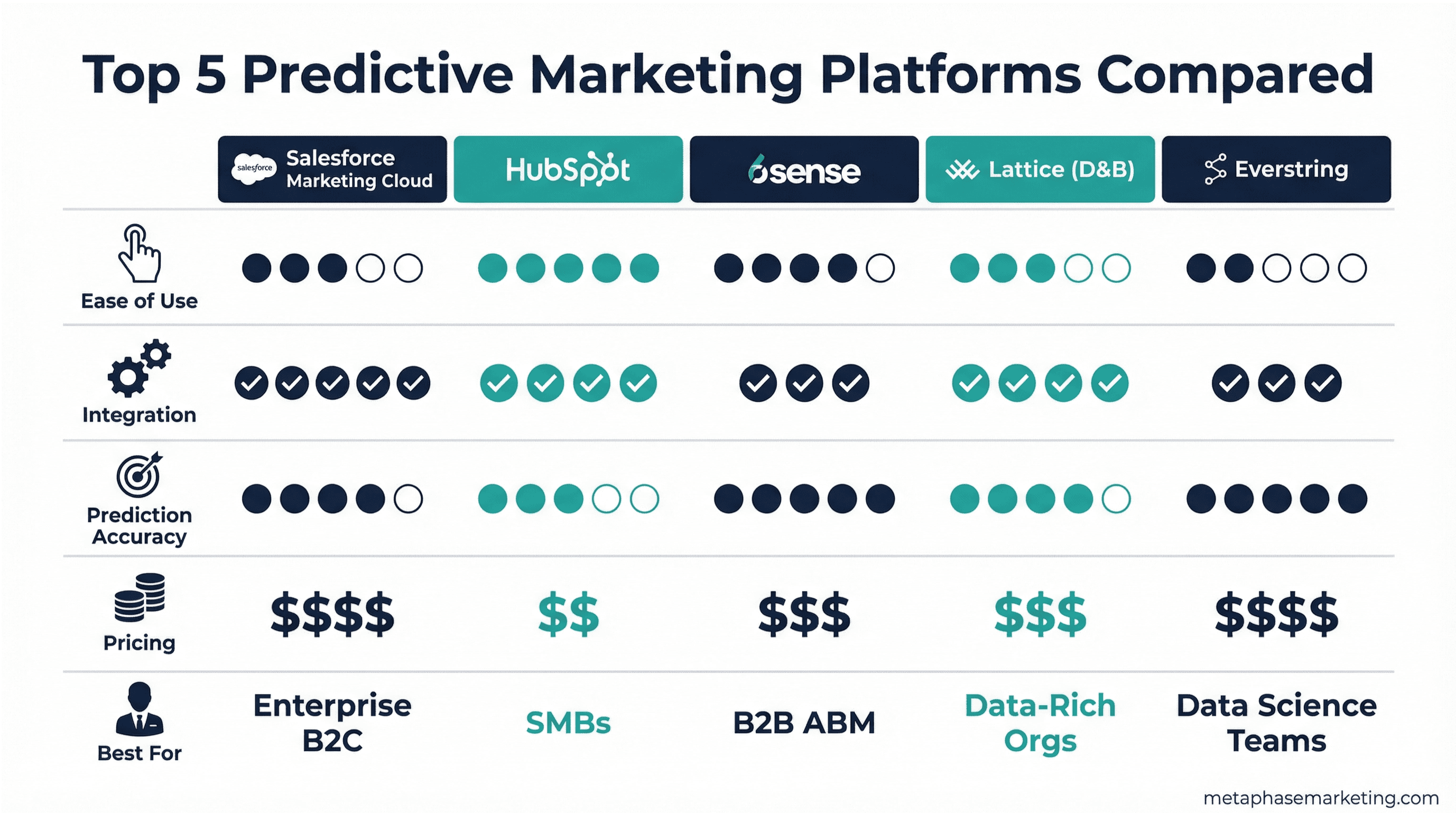
Alright, let's break down how these top predictive marketing platforms stack up against each other. It's not just about features; it's about what they can actually do for your marketing efforts in 2026. We've looked at a bunch of things, from how they handle your data to how easy they are to actually use day-to-day.
The goal here is to give you a clear picture so you can pick the right tool for your team.
Here’s a quick look at the key differences:
Platform | Primary Focus | Data Integration | Predictive Capabilities | Ease of Use (Subjective) | Key Differentiator |
|---|---|---|---|---|---|
Salesforce Marketing Cloud Intelligence | Unified Marketing Analytics & Optimization | Extensive (500+ sources), robust transformation | AI-driven insights, campaign forecasting, audience scoring | Moderate | Deep data governance and enterprise-level reporting |
HubSpot Marketing Hub | Inbound Marketing & CRM Integration | Strong within HubSpot ecosystem, growing third-party | Lead scoring, predictive lead routing, content suggestions | High | All-in-one inbound marketing and sales platform |
6sense | Account Engagement & Predictive Targeting | Connects with CRM, MAP, and ad platforms | Intent data analysis, account scoring, predictive analytics | Moderate | Focus on B2B account identification and engagement |
Lattice (by Dun & Bradstreet) | Customer Data Platform & Analytics | Broad, including D&B's own data assets | Customer lifetime value prediction, churn prediction | Moderate | Leverages D&B's vast business data for insights |
Everstring | B2B Data & Predictive Analytics | Integrates with major CRM and MAPs | Predictive modeling for lead and account scoring | Moderate | Specializes in high-quality B2B data enrichment |
Choosing the right platform often comes down to your specific business needs and existing tech stack. Don't just pick the one with the most features; consider which one will actually help you achieve your marketing goals faster and more efficiently. It's about finding that sweet spot between power and practicality.
When you're looking at these platforms, think about what kind of data you have, what you want to predict, and how your team will use the insights. For instance, if you're already deep in the Salesforce ecosystem, Marketing Cloud Intelligence might be a natural fit. If you're focused on inbound and need a simpler, integrated solution, HubSpot is a strong contender. For B2B companies looking to pinpoint high-intent accounts, 6sense and Everstring shine. Lattice offers a unique angle with Dun & Bradstreet's data. We've found that understanding these differences is key to making a smart choice, and you can explore more about data analytics platforms here. Remember, the best platform is the one that works best for you.
Conclusion
So, we've looked at some pretty powerful tools for predicting what your customers might do next. It's clear that platforms like Salesforce Marketing Cloud Intelligence, HubSpot, 6sense, Lattice, and Everstring are really changing the game. They're not just about looking at past sales numbers anymore; they're trying to figure out what's coming next.
The big takeaway here is that predictive marketing isn't just a buzzword; it's becoming a necessity. If you're not using data to guess what your customers want before they even know it themselves, you're probably falling behind. These platforms help you figure out who's likely to buy, when they might buy, and what message will actually get them to click.
Here’s a quick rundown of what makes them stand out:
Data Integration: Getting all your marketing data in one place is key. The best platforms make this easier.
Predictive Accuracy: How good are they at actually guessing right? This is where the real magic happens.
Actionable Insights: It's not enough to just know something; you need to know what to do with that information. Can the platform tell you what campaign to run or which lead to focus on?
Ease of Use: Some tools are super complex, while others are more straightforward. You need to pick one that fits your team's skills.
Choosing the right predictive marketing platform means looking beyond just the features. It's about finding a partner that can help you connect with customers more effectively and make smarter decisions, faster. Think about what your business needs most right now – is it better lead scoring, more personalized campaigns, or understanding customer churn? The platform you pick should directly address those needs.
Ultimately, the goal is to stop guessing and start knowing. By adopting these kinds of tools, businesses can prepare for the evolving landscape and build stronger customer relationships. You can find more expert marketing predictions for 2026 here.
Wrapping It Up
So, we've looked at some pretty cool tools that can help you get ahead of the game with your marketing. It’s clear that knowing what your customers might do next is a big deal. These platforms, from Salesforce to Improvado and others, are built to give you that edge. They pull in all your data, make sense of it, and even guess what’s coming down the pike. Picking the right one really depends on what your team needs and what you're trying to achieve. But honestly, using any of these is going to be way better than just guessing. It’s about making smarter moves with your marketing budget and actually connecting with people in a way that makes sense to them. Give them a try, see what works for you, and get ready to see some better results.
Frequently Asked Questions
What is a predictive marketing platform?
A predictive marketing platform is a tool that uses data and smart computer programs to guess what customers might do in the future. It helps businesses plan better ads and messages by looking at past actions and finding patterns.
How do predictive marketing platforms help businesses?
These platforms help businesses by showing them what their customers like and what they might buy next. This way, companies can send the right message to the right people, which can lead to more sales and happier customers.
Are predictive marketing platforms hard to use?
Most modern platforms are made to be easy for everyone to use, even if you’re not a tech expert. They often have simple dashboards, easy-to-read reports, and guides to help you get started.
Can small businesses use predictive marketing platforms?
Yes, many predictive marketing platforms have plans for small businesses. They offer simple tools and support so that even smaller teams can use data to make smarter choices.
How do these platforms collect their data?
Predictive marketing platforms collect data from lots of places, like websites, social media, emails, and ads. They put all this information together to give a full picture of how customers act.
Is my data safe with these platforms?
Most top platforms take data security seriously. They use strong protections to keep your information safe and follow rules to make sure your data is handled the right way.