
Carlos Courtney
Meta Ads
The 2026 Meta Ad Specs & Size Guide (All Formats)
Alright, so you're trying to get your ads seen on Facebook and Instagram in 2026, and you're wondering about the right sizes. It can get a little confusing with all the different places your ads can show up, like the feed, Stories, or Reels. Plus, with Meta taking over, you might think things have changed a lot. But honestly, it's pretty straightforward once you know the basics. We're going to break down the meta ad sizes specifications 2026 so you can stop guessing and start making ads that actually look good and work well.
Key Takeaways
Meta and Facebook ad sizes are the same; the platform rebrand didn't change any technical specs.
The 1080x1080 square format works for about 80% of ad placements and is a safe bet.
For feed ads, 1080x1350 (4:5 vertical) often performs better because it takes up more mobile screen space.
Stories and Reels ads should be 1080x1920 (9:16 vertical) to fill the entire screen.
Always check Meta's official Ads Guide and use preview tools to see how your ads will look before launching.
Introduction
Alright, let's talk about Meta ads for 2026. If you're running ads on Facebook or Instagram, or really any of Meta's platforms, you need to know the latest specs. Things change, and what worked last year might not be the best approach now. It's not just about slapping an image and some text together anymore; it's about making sure your ads look good and work well everywhere people are seeing them.
The biggest takeaway is that the core ad specs haven't really changed since the Facebook to Meta rebrand. So, if you've been keeping up with Facebook ad sizes, you're already in a good spot. The terminology might be different in presentations – you'll want to use "Meta" for future-proofing – but the actual dimensions and character limits in the ad manager are the same. It's more of a name change than a technical overhaul.
Why does this matter so much? Because using the right ad specs directly impacts how your ads perform. Wrong sizes can mean blurry images, cut-off text, or ads that just don't look right on certain placements. This can lead to lower engagement and, frankly, wasted money. We're talking about making sure your visuals are sharp and your message gets across clearly, whether someone's scrolling through their feed or checking out Stories.
Here's a quick rundown of what we'll cover:
Facebook Feed Image Ads
Instagram Feed Image Ads
Stories Ads (both platforms)
Video Ad considerations
And a few other placements you might be using.
Understanding these details helps you create ads that actually get seen and get results. It's about being smart with your creative and your budget. Think of it like this: you wouldn't try to fit a square peg in a round hole, right? The same applies to your ads. Getting the dimensions right is step one to making sure your campaigns are effective.
The goal is always to make your ad fit the space it's shown in perfectly. This means paying attention to aspect ratios and resolutions for different placements like the Facebook Feed, Instagram Stories, or even the Audience Network. It's not just about the size, but how the ad looks and feels in that specific environment.
We'll break down the specifics for each major placement so you can get it right the first time. This guide is designed to be your go-to resource for all things Meta ad specs in 2026, helping you avoid common pitfalls and optimize your campaigns for better performance. For instance, knowing the character limits for headlines and primary text is key to crafting concise, impactful ad copy that doesn't get cut off. You can find more details on how businesses are transformed through strategic implementation here.
Let's get started on making your ads shine across the Meta ecosystem.
Facebook Ad Specs 2026
Alright, let's get down to the nitty-gritty of Facebook ad specs for 2026. It's not super complicated, but you do need to pay attention to the details if you want your ads to look sharp and perform well. The key is matching your creative to the placement.
Facebook, like its sibling Instagram, has a bunch of different places your ads can show up, and each one has its own ideal dimensions. Using the right facebook ad sizes 2026 means your ad won't get awkwardly cropped or look blurry. It's all about making sure your message hits home without any visual distractions.
Here's a breakdown of some common formats and their requirements:
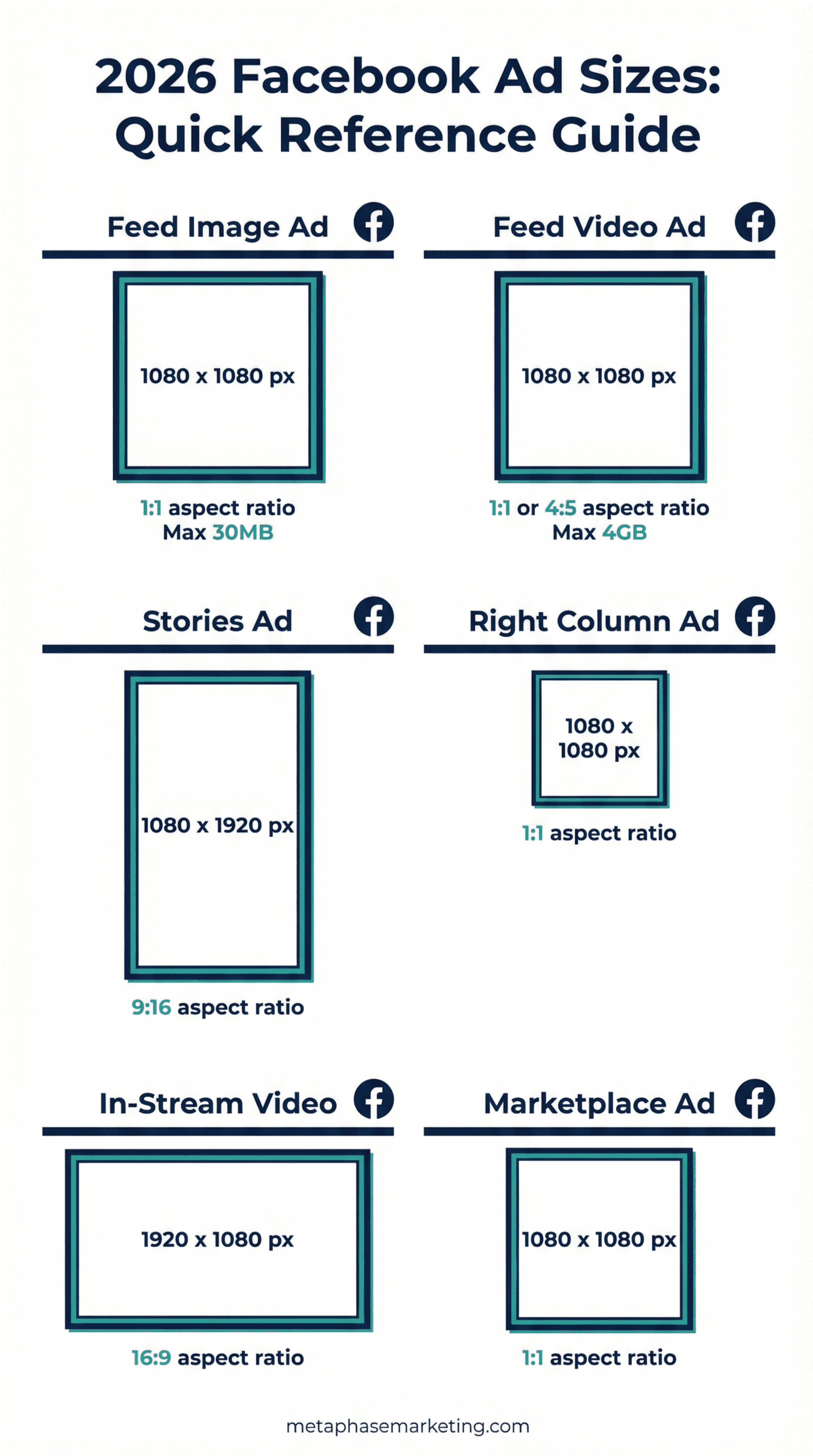
Feed Ads: These are the ones most people see when they're scrolling through their news feed. For images, you've got a couple of good options. The 1:1 square format (1080 x 1080 pixels) is a solid all-rounder, but the 4:5 vertical format (1080 x 1350 pixels) often performs even better because it takes up more space on mobile screens. For videos, the same ratios apply, with a maximum length of 241 minutes, though shorter is usually better for engagement. Remember, the maximum file size for images is 30 MB, and for videos, it's a hefty 4 GB.
Stories Ads: These are the full-screen, vertical ads that pop up between user Stories. For these, you'll want to use a 9:16 aspect ratio, so think 1080 x 1920 pixels. Keep videos under 15 seconds if possible to hold attention.
Right Column Ads: These appear on the right side of Facebook on desktop. For 2026, these exclusively use a 1:1 square format (1080 x 1080 pixels).
When you're planning your campaigns, it's smart to think about using the same creative across different placements. Meta Ads Manager lets you do this, but you might need to adjust your assets slightly. For instance, a video that looks great in the feed might need a different cut for Stories. It's worth checking out the official Meta advertising dimensions 2026 for the most up-to-date details.
Always start with high-resolution source files. Trying to stretch a small image or video to fit a larger ad space will almost always result in a blurry, unprofessional-looking ad. It's better to have a slightly simpler creative that looks crisp than a complex one that's pixelated.
Don't forget about the text limits either. While image and video specs are visual, the copy is what often drives the action. Keep your headlines concise and your primary text informative but easy to digest. Testing different formats and sizes is really the best way to see what works for your specific audience and goals.
Instagram Ad Specs 2026
Alright, let's talk Instagram ads for 2026. It's still a super visual platform, so getting your images and videos just right is key. You've got a few main places ads can show up: the Feed, Stories, and Explore. Each has its own little quirks, but Meta tries to make it somewhat universal with their cross-platform guidelines, which is handy.
For your standard Instagram Feed ads, think about the image specs. You're generally looking at JPG or PNG files, with a maximum size of 30MB. The resolution should be at least 1080 pixels wide. While square (1:1) is common, Meta also supports landscape (1.91:1) and vertical (4:5) ratios. Just remember, if you're aiming for maximum impact in the grid view, images often get cropped to a 3:4 aspect ratio, so keep your important stuff centered.
When it comes to video, the same file types (MP4, MOV) apply, and the file size can go up to 4GB. Video length can be up to 60 minutes for feed placements, though shorter is usually better for keeping attention. Sound is optional but recommended for engagement.
Instagram Stories are a whole different ballgame, demanding a vertical 9:16 aspect ratio. These are full-screen, so make sure your creative fills the space nicely. The recommended resolution is 1080 x 1920 pixels.
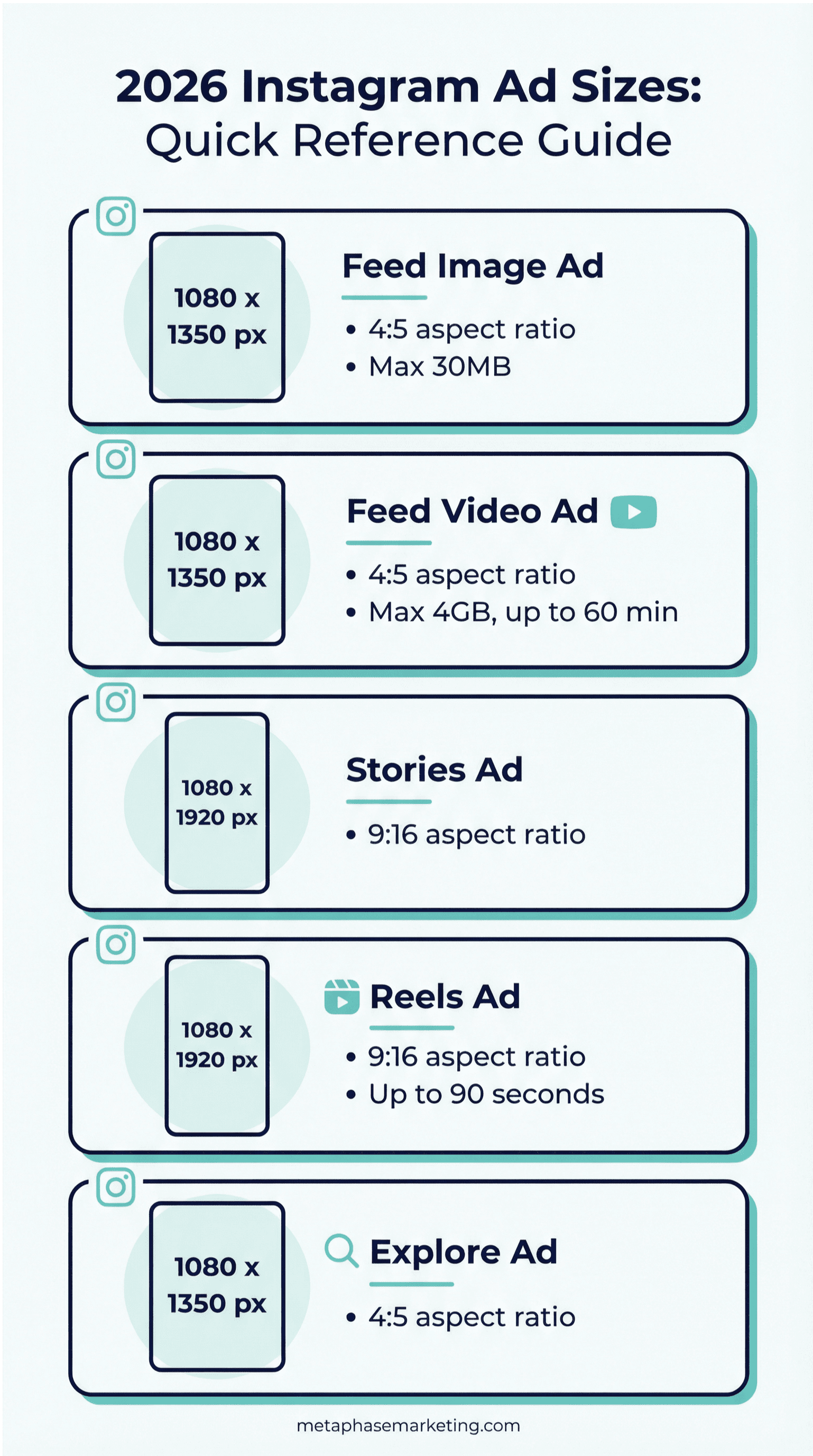
Here's a quick rundown of common Instagram ad formats and their requirements:
Feed Image Ads:
File Type: JPG, PNG
Max File Size: 30 MB
Min Resolution: 1080 x 1080 px
Aspect Ratios: 1:1 (square), 1.91:1 (landscape), 4:5 (vertical)
Feed Video Ads:
File Type: MP4, MOV
Max File Size: 4 GB
Max Length: 60 minutes
Resolution: 1080 x 1080 px minimum
Aspect Ratios: 1:1, 9:16, 1.91:1
Stories Ads (Image & Video):
Aspect Ratio: 9:16
Resolution: 1080 x 1920 px
File Type: JPG, PNG (images); MP4, MOV (video)
Max File Size: 30 MB (images); 4 GB (video)
Keep in mind that Meta's ad system is always evolving. It's a good idea to check the latest Meta ad format guidelines periodically, especially if you're running campaigns across both Facebook and Instagram. The goal is always to make sure your ads look sharp and load quickly, no matter where they appear.
Don't forget about the text limits either. Primary text usually has a limit of around 125 characters, and headlines around 40. These are important details when you're crafting your ad copy to fit the instagram ad creative requirements.
BONUS: What is the Average Cost of Facebook Ads in 2026?
Alright, let's talk about the money side of things. Figuring out the exact facebook ad cost 2026 is a bit like trying to nail jelly to a wall – it moves! Prices can change based on a ton of factors, like who you're trying to reach, what time of year it is, and even what your competitors are up to. It's not a one-size-fits-all number, you know?
But we can look at some general trends. As of early 2026, you might see average costs per click (CPC) hovering around $0.70 for campaigns focused on driving traffic. If your goal is to get leads, that number can jump up to about $1.92 per click. For every thousand times your ad is shown (that's CPM), expect something in the ballpark of $18 to $24. Remember, these are just averages, and your actual costs could be higher or lower.
Here's a quick breakdown of what influences the price:
Audience Targeting: Reaching a super specific or in-demand audience usually costs more.
Ad Placement: Where your ad shows up matters. Feed ads might have different costs than ads in Stories.
Competition: If a lot of advertisers are bidding for the same audience, prices go up.
Time of Year: Think holidays or major events – ad costs often spike then.
Ad Quality & Relevance: Better ads can sometimes get you better prices.
It's really important to remember that focusing solely on the lowest cost isn't always the best strategy. Sometimes paying a bit more for a highly targeted audience or a more engaging ad format can lead to much better results for your business. Think about the overall return on your investment, not just the upfront expense.
When you're setting up your campaigns, Facebook offers different objectives like Awareness, Traffic, Engagement, Leads, App Promotion, and Sales. Choosing the right one for your goal is key to managing your budget effectively. It's all about getting the most bang for your buck, and that means understanding how these costs play out and how to optimize your campaigns for sustainable business growth.
So, while there's no single magic number for facebook ad cost 2026, keeping these factors in mind will help you budget and plan more realistically. It's a dynamic game, but with a good strategy, you can make it work for you.
Quick Reference Cheat Sheet (Infographic)
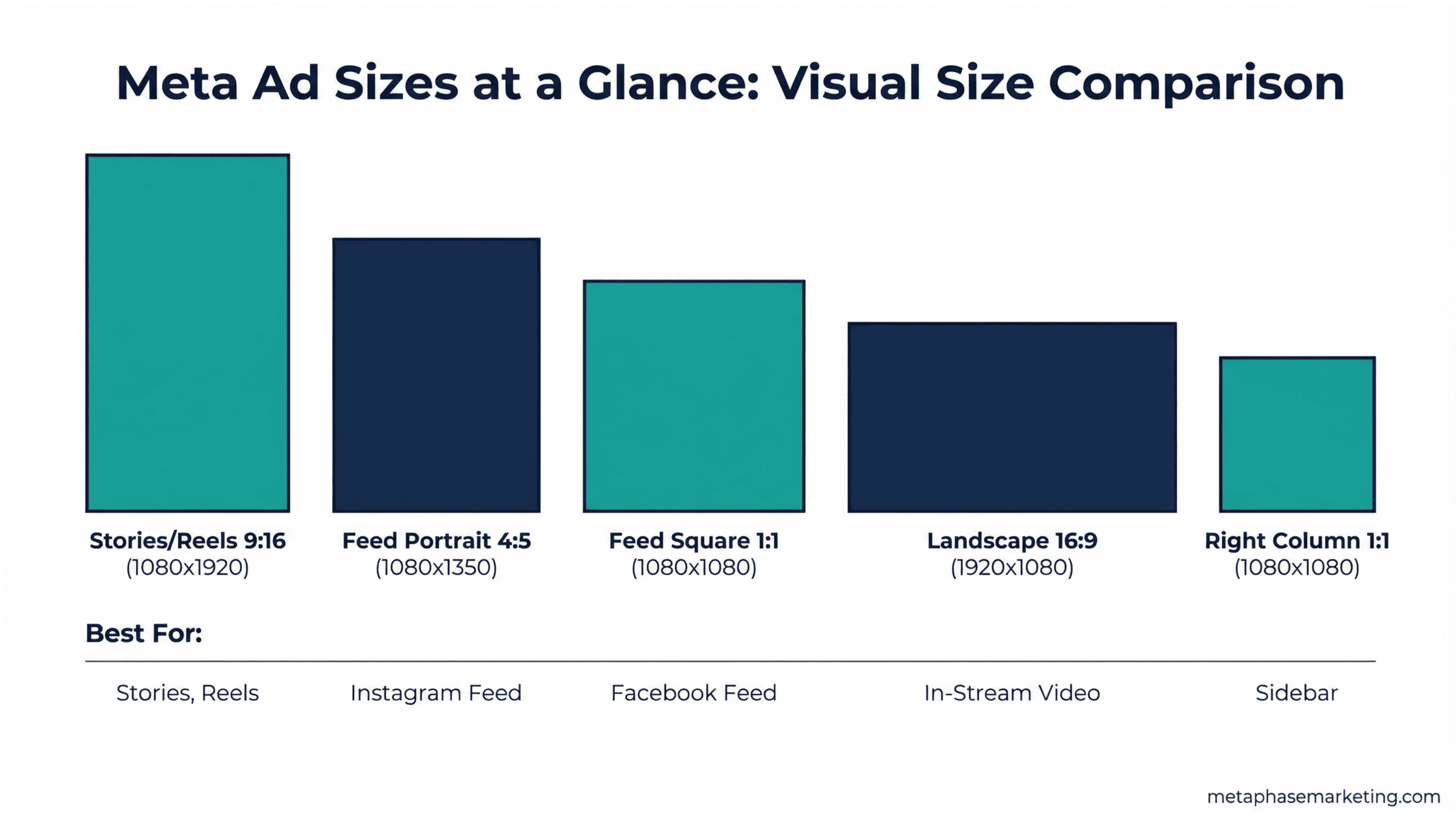
Alright, let's get down to the nitty-gritty. Keeping track of all the ad specs can feel like a full-time job, right? Especially with Meta's platforms constantly evolving. But honestly, the biggest thing to remember is that Meta and Facebook ad specs are the same thing now. No need to stress about different dimensions just because they changed the name.
The most flexible ad size you can use is 1080x1080 pixels (a perfect square). This works for about 80% of all the places your ads can show up, which is pretty handy. Think of it as your go-to if you're short on time or resources.
Here's a quick rundown of the main specs you'll bump into:
Placement | Recommended Size | Aspect Ratio | Max File Size |
|---|---|---|---|
Feed (Image) | 1080x1080 or 1080x1350 | 1:1 or 4:5 | 30MB |
Feed (Video) | 1080x1080 or 1080x1350 | 1:1 or 4:5 | 4GB |
Stories/Reels | 1080x1920 | 9:16 | 30MB/4GB |
Right Column | 1080x1080 | 1:1 | 30MB |
Carousel | 1080x1080 per card | 1:1 | 30MB/card |
Messenger | 1200x628 | 1.91:1 | 30MB |
When you're putting text on your images, keep it light. Meta used to have a strict rule about text percentage, and while they got rid of it, ads with less text on the image itself tend to do better. Use the actual ad copy fields for your main message. It's all about making sure your visuals pop and your message is clear without being cluttered.
Before you hit launch on any campaign, do a quick check. Make sure your images are at least 1080 pixels wide, that any text is readable on mobile (think 14pt font or bigger), and that your videos have captions. Also, double-check those file sizes and character limits. It sounds like a lot, but a little prep goes a long way.
If you're creating a bunch of different ad variations, using Meta's Dynamic Creative feature can be a lifesaver. You just upload different sizes and ratios, and Meta's algorithm figures out which combinations work best for different people. It's a smart way to test without doing all the heavy lifting yourself. You can even check out the Facebook Ads Library to see what others are doing. It’s a great way to get ideas and see how competitors are sizing their ads.
Conclusion
So, we've gone through the nitty-gritty of Meta's ad specs for 2026. It's a lot to take in, I know. The main takeaway here is that while the platform has rebranded from Facebook to Meta, the actual ad dimensions and requirements haven't changed much. It's still the same game, just with a new name.
Getting these specs right is super important for making sure your ads actually get seen and perform well. It's not just about looking pretty; it's about making sure your message cuts through the noise on feeds and stories.
Here’s a quick rundown of what to keep in mind:
Vertical is King: With everyone glued to their phones, 4:5 and 9:16 formats are your best friends for feed and Stories/Reels. Don't forget these!
Square Still Works: The 1:1 format is still solid for versatility across different placements.
Text on Images: Less is more. Meta used to have a strict rule, but now it's more about what performs best. Keep text minimal on your visuals and use the ad copy fields.
Test, Test, Test: What works for one audience might not work for another. Always be testing different sizes and formats to see what clicks.
Remember that the platform is always evolving. What's standard today might shift a bit next year. Staying on top of these changes, even the small ones like updated text limits or new placement options, can make a real difference in your campaign's success. It’s about adapting to how people use the apps.
Ultimately, mastering these ad specifications is a key step in boosting your ad performance and getting more bang for your buck. It’s about making sure your ads are seen, understood, and acted upon. For more on how optimizing your operations can impact your business, check out how to boost EBITDA.
Keep these dimensions handy, use Meta's preview tools before you launch, and you'll be well on your way to creating ads that actually get results in 2026.
In conclusion, we've covered a lot of ground. We hope this information has been helpful. Ready to take the next step? Visit our website today to learn more and book your consultation!
Wrapping It Up
So, that's the lowdown on Meta ad sizes for 2026. It might seem like a lot to keep track of, but honestly, it boils down to a few key things. Remember that Meta and Facebook are the same thing now, so all your old knowledge still counts. Stick to the main sizes like 1080x1080 for general use, 1080x1350 for feeds, and 1080x1920 for Stories and Reels. Using the preview tools is a smart move, and testing different formats will show you what your audience actually likes. Don't overthink it too much; just get the basics right, and you'll be good to go.
Frequently Asked Questions
What's the best size for Facebook ads in 2026?
The best size for your Facebook ad really depends on where you want it to show up. A square picture, 1080 by 1080 pixels, works well in most places. But, for ads that appear in the main feed, a taller picture that's 1080 by 1350 pixels often gets more attention. And for Stories and Reels, you'll want a full-screen size of 1080 by 1920 pixels.
Are Meta ad sizes the same as Facebook ad sizes?
Yes, they are exactly the same! When Facebook changed its name to Meta, they didn't change the rules for ad sizes. Think of it like a new coat of paint on the same house. All the sizes and technical details you knew for Facebook ads are still good to go for Meta ads.
What's the ideal image size for ads in the Facebook feed?
For ads shown in the Facebook feed, a vertical image that's 1080 pixels wide and 1350 pixels tall (that's a 4:5 ratio) usually does the best. This size takes up more space on your phone screen, which can help people notice your ad more and interact with it.
How can I make sure my Facebook ads don't look blurry?
To avoid fuzzy ads, always start with a high-quality picture. Even though the recommended size might be 1080 by 1080 pixels, try uploading an image that's at least 1440 by 1440 pixels. For graphics with words, use a PNG file, and for photos, a good quality JPG works best. Never try to make a small picture bigger, as it will always look bad.
What are the video rules for Meta ads?
Meta lets you upload video ads that are up to 4 gigabytes in size and can be very long, but shorter videos often perform better. The recommended sizes are the same as images: 1080 by 1080 pixels for square, 1080 by 1350 pixels for vertical feed ads, and 1080 by 1920 pixels for Stories and Reels. It's best to use the MP4 format with H.264 coding.
Do I need different ad sizes for Instagram compared to Facebook?
Nope, Instagram uses the same Meta ad sizes as Facebook. A square picture that looks good in the Facebook feed will also look good in the Instagram feed. And the full-screen size for Stories and Reels is the same on both apps. The trick is to use the settings that let you fine-tune your ad for each specific spot where it might appear.