
Carlos Courtney
Political Ads
Political Lead Generation Forms vs Website Landing Pages: 2025–2026 Conversion Data
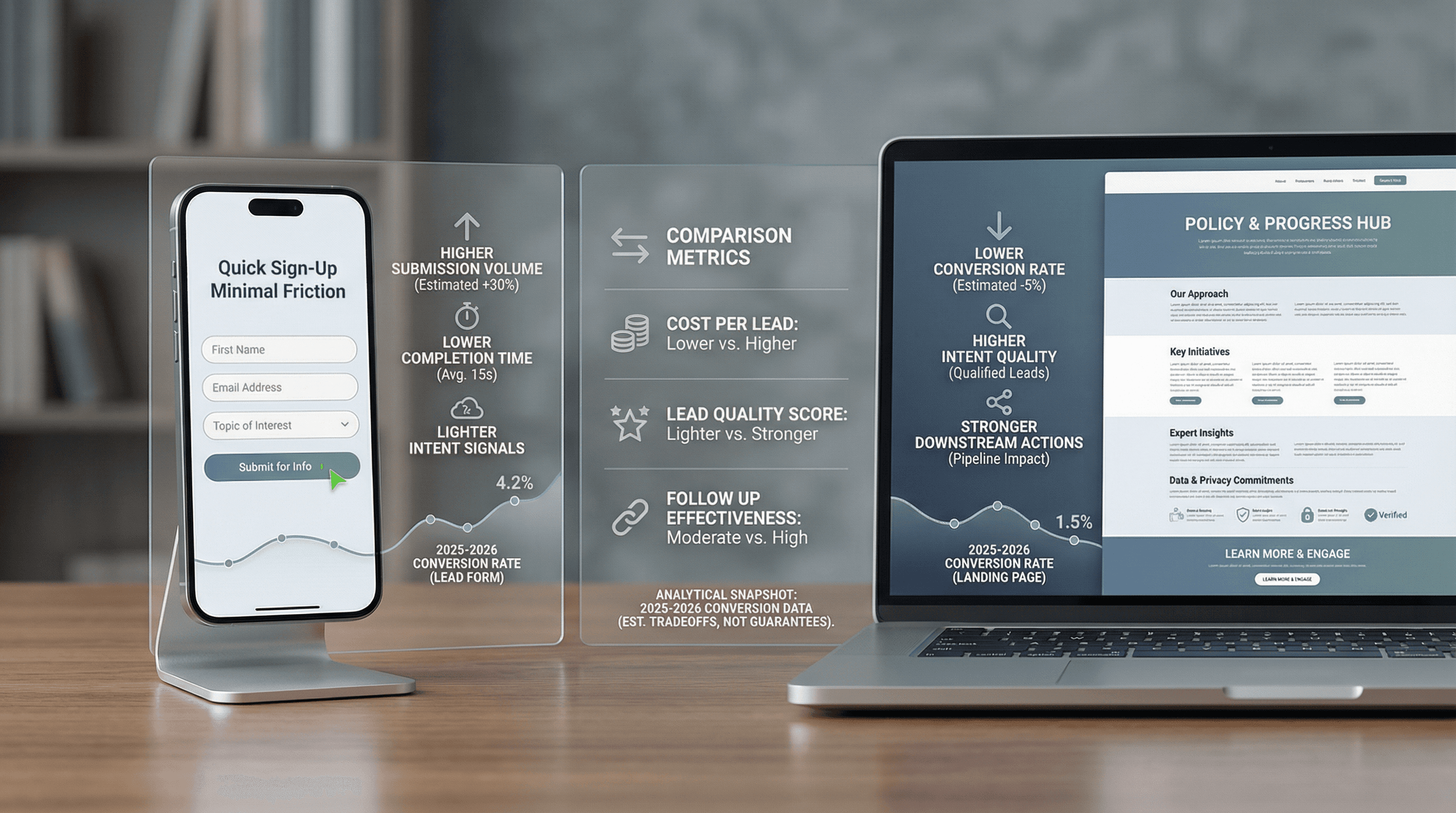
So, you're trying to get more people involved in your political campaign, right? It's all about getting those sign-ups and making sure people feel connected. We've been looking at what worked best for political lead generation forms and website landing pages over the last year or so, up to 2026. Turns out, making things simple and clear is a big deal. People are busy, and they want to know what you stand for without a lot of fuss. We'll break down how different approaches are helping campaigns connect with voters and get them to take action.
Key Takeaways
Keeping political lead generation forms short and sweet is a major win. Asking for less information upfront means more people will actually fill them out.
Using multi-step forms can make the sign-up process feel less overwhelming, guiding people through it more smoothly and leading to more completed forms.
Landing pages that use video tend to grab attention better and explain things clearly, which helps get more people to sign up.
Making sure your website and forms work well on phones is super important, as a lot of people are browsing and signing up that way.
Personalizing your messages and calls to action, even just a little bit, makes a big difference in getting people to respond.
Optimizing Political Lead Generation Forms for Maximum Impact

When it comes to getting people to sign up, donate, or volunteer, the form itself is a big deal. It's not just a bunch of boxes to fill out; it's a direct line to potential supporters. If it's clunky or asks for too much, people will just leave. We've seen that making forms simpler can really pay off. Think about it: nobody wants to spend ages typing out their life story just to show interest in a campaign.
The Power of Concise Forms: Reducing Fields for Higher Conversions
This is probably the most straightforward way to boost how many people actually finish your form. Every extra field you add is another hurdle. We're talking about a significant jump in conversions – sometimes over 150% – just by cutting down the number of required fields. For instance, going from eleven fields down to just four can make a huge difference. It lowers the mental effort needed and makes the whole process feel less like a chore, especially on a phone where typing can be a pain.
Fewer fields mean less friction.
Reduces the chance of abandonment.
Improves user experience, particularly on mobile.
We're seeing a trend where campaigns are using what's called progressive profiling. This means they ask for just the basics – maybe name and email – upfront. Then, as the supporter engages more, they can ask for additional details later. It's a smarter way to build a relationship without overwhelming someone right at the start.
Multi-Step Forms: A Smoother Path to Political Engagement
It might seem counterintuitive, but breaking a longer form into smaller, manageable steps can actually lead to better results. Studies show that multi-step forms can outperform single-step ones by about 14%. Why? Because it feels less daunting. Each step is a small win, and seeing a progress bar can make people feel like they're moving forward rather than getting stuck.
Breaking down a form into multiple stages makes the process feel less intimidating. It guides the user through a series of smaller, achievable actions, which can significantly improve completion rates compared to a single, long form.
These forms work even better when they have clear indicators of progress, like a visual bar showing how far along the user is. This gamified approach makes the experience feel more like a guided journey and less like a bureaucratic task. It's especially useful for complex sign-ups or detailed surveys where asking for everything at once would scare people away.
Progressive Profiling and Conditional Logic in Form Design
Progressive profiling is all about gathering information over time, not all at once. You start with the essentials and then, based on how a user interacts with your campaign later, you can ask for more specific details. This respects the user's time and privacy. Conditional logic takes this a step further. It means the form can change based on the answers given. For example, if someone indicates they're interested in a specific policy, the form might then ask a follow-up question related to that policy. This makes the interaction feel more personal and relevant to the individual, showing you're paying attention to their specific interests.
Leveraging Landing Page Strategies for Political Campaigns

When it comes to getting people to take action in a political campaign, your landing page is often the first real point of contact after someone clicks an ad or a link. It's not just a place to dump information; it's a carefully designed space meant to guide visitors toward a specific goal, like signing up to volunteer or donating. Getting this right can make a huge difference in how many people actually get involved.
The Compelling Influence of Video on Political Landing Pages
Video has become a really big deal on landing pages, and for good reason. Think about it: a short video can explain a candidate's stance on a complex issue way faster and more engagingly than a block of text. It helps build trust, too. Seeing and hearing a candidate or a supporter speak directly can create a connection that words alone often can't. We're seeing that short videos, around 30 to 60 seconds, often work best, especially if they're set up to play automatically without sound. These can be quick testimonials or a brief overview of a key policy. The data shows that landing pages with video can see conversion rates jump by as much as 86%. It's not just about looking good; it's about making information easy to digest and building that all-important emotional connection.
Long-Form Landing Pages: Building Trust and Context for Voters
While short and punchy has its place, sometimes you need more space. Long-form landing pages are great when you have a lot to explain or when you're trying to build a deep sense of trust. These pages allow you to go into detail about a candidate's platform, share success stories, address potential concerns, and really lay out the vision for the future. It's about providing context and showing voters you've thought through the issues. Think of it like a detailed conversation rather than a quick chat. For complex issues or when you're trying to win over undecided voters, giving them all the information they need in one place can be incredibly effective. It shows you're serious and transparent.
Minimalist Landing Page Design: Clarity Over Clutter
On the flip side, sometimes less is more. A minimalist landing page focuses on one clear message and a single call to action. This approach cuts out distractions, making it super easy for visitors to know exactly what you want them to do. With people's attention spans getting shorter, especially on mobile, a clean design with strong visuals and straightforward text can be a winner. Pages with fewer elements, say under ten, tend to perform much better than those that are overloaded. It's all about making the path to conversion as smooth and obvious as possible. If a page has too many buttons, links, or fields, people can get confused and just leave.
Personalization and Interactive Content in Political Outreach
Let's talk about making your political outreach feel less like a generic flyer and more like a real conversation. In 2025 and looking into 2026, just shouting your message into the void isn't cutting it anymore. People expect things to be tailored to them, and honestly, who can blame them? We're all bombarded with information, so when something actually speaks to our specific interests or concerns, it grabs our attention.
Personalized Calls-to-Action: Connecting with Individual Voters
Think about your own inbox. Those emails that start with "Dear [Your Name]" and mention something you actually care about? They're way more likely to get opened than the "Dear Valued Supporter" ones. The same applies to political campaigns. Instead of a generic "Donate Now," a call-to-action like "Help us fund the local park initiative in your neighborhood" or "Sign the petition to improve school funding in District 5" feels much more direct and impactful. This level of personalization shows voters you're paying attention to their local issues and concerns. It's about making the ask feel relevant to their world.
Interactive Content: Engaging Constituents with Quizzes and Tools
Static content is fine, but interactive stuff? That's where the magic happens. Imagine a quick quiz asking voters about their stance on a few key local issues. Based on their answers, you can then show them exactly where your candidate stands on those same topics. Or maybe a simple calculator that shows how a proposed policy might affect their property taxes. These tools don't just gather information; they educate and engage. Data from 2025 shows that interactive content can boost conversions by as much as 28% compared to plain old text or images. It's a fun way to get people involved without feeling like a hard sell.
Here's a quick look at how different types of interactive content performed:
Quizzes: Great for gauging voter sentiment and educating on specific issues.
Calculators: Useful for demonstrating the tangible impact of policies on voters' lives.
Polls/Surveys: Simple ways to gather opinions and make voters feel heard.
AI-Driven Personalization for Targeted Political Messaging
Now, this is where things get really interesting for 2026. Artificial intelligence is starting to play a bigger role. AI can analyze vast amounts of data to figure out what messages are most likely to connect with different groups of voters. It's not just about using someone's name; it's about understanding their past behavior, their likely interests, and even predicting what issues they might care about next. This allows campaigns to send highly targeted messages, whether it's an email, a social media ad, or even a personalized section on a website. It means less wasted effort and a better chance of actually getting your message across to the people who need to hear it.
The goal here is to move beyond broad demographic targeting and get to a point where each voter feels like they're receiving a message crafted just for them. This requires sophisticated data analysis, but the payoff in terms of engagement and conversion is significant. It's about building genuine connections, one personalized interaction at a time.
Mobile-First Approaches for Political Lead Generation
Okay, so let's talk about phones. It’s pretty obvious by now that most people are looking at websites on their phones, right? For political campaigns, this isn't just a nice-to-have; it's pretty much the main event. If your site isn't working well on a small screen, you're probably losing a lot of potential supporters. We saw mobile conversion rates hovering around 1.82% compared to 3.9% on desktops in 2025, but that gap is shrinking fast. It’s not enough to just have a website that looks okay on a phone anymore. We’re talking about a real mobile-first strategy.
Bridging the Mobile-Desktop Conversion Gap
So, how do we get more people to actually do something on their phones? It’s about making things super easy. Think about forms – nobody wants to type a novel on a tiny keyboard. Keeping forms short, maybe just asking for a name and email, makes a huge difference. We also saw that multi-step forms, where you break down the request into smaller chunks, convert better than one long form. It feels less like a chore. Adding things like one-click payments or pre-filled information can also speed things up a lot. Basically, if it feels clunky or takes too long on a phone, people will just leave.
Progressive Web Apps for Enhanced Mobile Political Engagement
Progressive Web Apps, or PWAs, are kind of like a middle ground between a regular website and a mobile app. They load fast, work offline sometimes, and can even send you notifications. For campaigns, this means you can offer a really smooth experience without people having to go through the app store. Imagine a PWA where people can quickly find polling locations, sign up to volunteer with just a couple of taps, or get instant updates on campaign events. It makes engaging with your campaign feel more immediate and less like a hassle.
Voice Search Optimization for Political Queries
Think about how often people use voice assistants these days – asking Siri, Alexa, or Google for directions, information, or to set reminders. This is only going to get bigger. For political campaigns, this means we need to think about how people ask questions out loud. Instead of just optimizing for keywords, we need to consider natural language questions. If someone asks, "What's Candidate X's stance on healthcare?" your website content should be able to answer that clearly and directly. It’s about making sure your campaign information is easily discoverable when people are on the go and just want a quick answer.
The shift to mobile isn't just about screen size; it's about user behavior and expectations. People want speed, simplicity, and relevance, especially when they're on the move. Failing to adapt means missing out on a huge chunk of potential engagement and support.
Here’s a quick look at what makes a mobile experience better:
Speed: Pages need to load almost instantly. Slow loading times are a conversion killer.
Simplicity: Forms and navigation should be straightforward and easy to use with one hand.
Clarity: Key messages and calls-to-action must be prominent and easy to understand.
Accessibility: Ensure content is readable and usable for everyone, regardless of ability.
Data-Driven Optimization for Political Lead Generation
Okay, so we've talked a lot about how to get people to sign up or engage. But how do we actually know what's working best, and how can we make it even better? That's where data comes in. Relying on gut feelings just doesn't cut it anymore, especially with how fast things change. We need to look at what people are actually doing on our sites and forms.
The Role of Multivariate Testing in Campaign Optimization
Think of multivariate testing like throwing a bunch of different ingredients into a recipe at once to see which combination tastes best. Instead of just testing one thing (like changing a button color), you're testing multiple elements on a page simultaneously – maybe a different headline, a new image, and a revised call-to-action. This gives you a much clearer picture of how different parts of your page work together to get people to convert. It's more complex than simple A/B testing, but the insights can be way more detailed. For instance, you might find that a certain headline only works well with a specific image, something you'd miss with simpler tests.
Here’s a simplified look at what a multivariate test might compare:
Element | Variation A | Variation B | Variation C |
|---|---|---|---|
Headline | "Vote for Change" | "Your Voice Matters" | "A Brighter Future" |
Image | Candidate Photo | Community Photo | Policy Infographic |
Call-to-Action | "Sign Up Now" | "Get Involved" | "Learn More" |
By running tests like these, we can pinpoint the exact combinations that lead to more sign-ups or donations. It’s about finding the sweet spot where all the elements align perfectly.
Web Accessibility: Expanding Reach for Political Campaigns
This is a big one that often gets overlooked. Making sure your website and forms are accessible to everyone, regardless of ability, isn't just the right thing to do – it's smart strategy. People with disabilities make up a significant portion of the electorate. If your site isn't usable with screen readers, keyboard navigation, or has proper color contrast, you're essentially shutting the door on potential supporters. Think about it: if someone can't easily fill out your form or read your message, they're not going to become a lead.
Key areas to focus on include:
Keyboard Navigation: Can users tab through all interactive elements and activate them using just the keyboard?
Screen Reader Compatibility: Is your content properly structured with headings and alt text for images so screen readers can interpret it?
Color Contrast: Is there enough contrast between text and background colors to make content readable for people with visual impairments?
Clear Form Labels: Are form fields clearly labeled so users know what information is required?
Ignoring accessibility means missing out on a whole segment of voters who want to engage but are blocked by technical barriers.
Analyzing Behavioral Data for Smarter Lead Nurturing
Once you've got a lead, the work isn't over. Analyzing how people interact with your emails, website content, and previous communications tells you a lot about their interests and where they are in their decision-making process. Did they click on a link about education policy? Did they download a PDF on economic plans? This behavioral data is gold. It allows you to segment your leads and send them more targeted follow-up messages, rather than just blasting generic emails to everyone.
Understanding user journeys and engagement patterns allows for highly personalized follow-up. Instead of a one-size-fits-all approach, we can tailor communication based on demonstrated interests, increasing the likelihood of conversion down the line. This isn't just about sending more emails; it's about sending the right emails to the right people at the right time.
For example, if a lead consistently engages with content about environmental issues, future communications should prioritize that topic. This shows you're listening and makes the constituent feel understood, which is a powerful tool in building support.
Emerging Trends in Political Lead Generation for 2026
As we look ahead to 2026, the political landscape for lead generation is set to evolve, driven by shifts in technology and voter behavior. It's not just about getting names on a list anymore; it's about building genuine connections and understanding what motivates people.
The Rise of Invisible Forms and Passive Data Collection
Forget those clunky forms that interrupt the user experience. By 2026, we'll see more "invisible" forms that collect data in the background as users interact with content. Think about a voter reading an article about a policy issue; instead of a pop-up asking for their email, the system might subtly note their interest based on dwell time and scroll depth. This passive data collection, when done ethically, can provide insights without demanding immediate action. This shift prioritizes a smoother user journey, making the initial interaction less about a transaction and more about engagement. It's about meeting voters where they are, not forcing them into a predefined funnel. This approach requires careful consideration of privacy and transparency, of course.
Augmented Reality's Potential in Political Campaigns
Augmented Reality (AR) might sound like science fiction for politics, but its potential is growing. Imagine a voter using their phone to see a virtual town hall superimposed on their living room, or an AR experience that shows the impact of a proposed local development project right in their neighborhood. These immersive experiences can make policy and candidate platforms more tangible and relatable. While widespread adoption for lead generation might still be a few years out, early experiments could focus on interactive AR elements on websites or social media that encourage deeper exploration of campaign issues. This could be a way to capture interest from a more tech-savvy segment of the electorate.
Real-Time Chatbots for Immediate Constituent Interaction
Chatbots are already common, but by 2026, they'll be far more sophisticated and integrated into real-time constituent interaction. We're talking about AI-powered chatbots that can handle complex queries, provide personalized information based on a voter's location or stated interests, and even guide them through the process of signing up for volunteer opportunities or donating. The key here is immediacy. Voters expect quick answers, and chatbots can provide that 24/7. This frees up human staff for more complex tasks and ensures that no potential supporter is left waiting. Building trust with these bots will be key, so focusing on clear communication and escalation to human agents when needed is vital. For a look at broader foreign policy trends that might influence the political climate, check out key foreign policy trends.
Here's a quick look at what these trends might mean:
Passive Data: Less friction, more insight.
AR: Making policy tangible and engaging.
Chatbots: Instant, personalized support.
The focus in 2026 will be on creating more natural, less intrusive ways to connect with voters. It's about building relationships through technology that feels helpful, not demanding. Campaigns that embrace these evolving methods will likely see better engagement and more qualified leads.
Wrapping It Up: What the Data Tells Us for 2025-2026
So, looking at the numbers from 2025 and heading into 2026, it's pretty clear that just having a website isn't enough anymore. Both political lead generation forms and dedicated landing pages have their place, but the real winners are those that adapt. We saw that simpler forms, fewer fields, and even multi-step approaches can really boost sign-ups. Video on landing pages is a huge draw, and personalization, whether it's a tailored CTA or a dynamic email, makes a big difference. Plus, don't forget about mobile – it's not just about looking good, it's about being fast and easy to use. Voice search optimization and interactive content are also becoming more important. Basically, if you're not paying attention to how users interact with your pages and forms, and making things as smooth and relevant as possible, you're probably leaving leads on the table. It’s all about making it easy and valuable for people to connect with you.
Frequently Asked Questions
Why are shorter forms better for getting people to sign up?
When forms ask for too much information, people might get tired or worried about sharing details. Shorter forms are easier and quicker to fill out, so more people will finish them. It's like asking for just their name and email instead of their whole life story!
How can videos help political campaigns on their websites?
Videos are super engaging! They can quickly explain what a candidate believes in or show them talking to people. This helps voters connect with the candidate and trust them more, which can lead to more support.
What's the deal with 'long-form' landing pages?
Think of a long-form page like a detailed story. It gives lots of information, explains things clearly, and builds trust. This is great when you need to explain something important or convince someone to take a big step, like donating or volunteering.
Why is it important for websites to work well on phones?
Most people use their phones to look at websites these days. If a website is hard to use on a phone, people will leave. Making sure everything looks good and is easy to click on a small screen helps get more people to sign up or take action.
What does 'personalization' mean for political websites?
Personalization means making the website feel like it's talking directly to each visitor. It's like showing a button that says 'Sign up to help in YOUR town' instead of just 'Sign up.' This makes people feel more connected and more likely to get involved.
How can chatbots help political campaigns online?
Chatbots are like helpful assistants on a website. They can answer common questions right away, 24/7. This gives people quick information and makes them feel heard, which can encourage them to take the next step, like signing up for updates.